
Emergency Water Damage Restoration Greenville NC
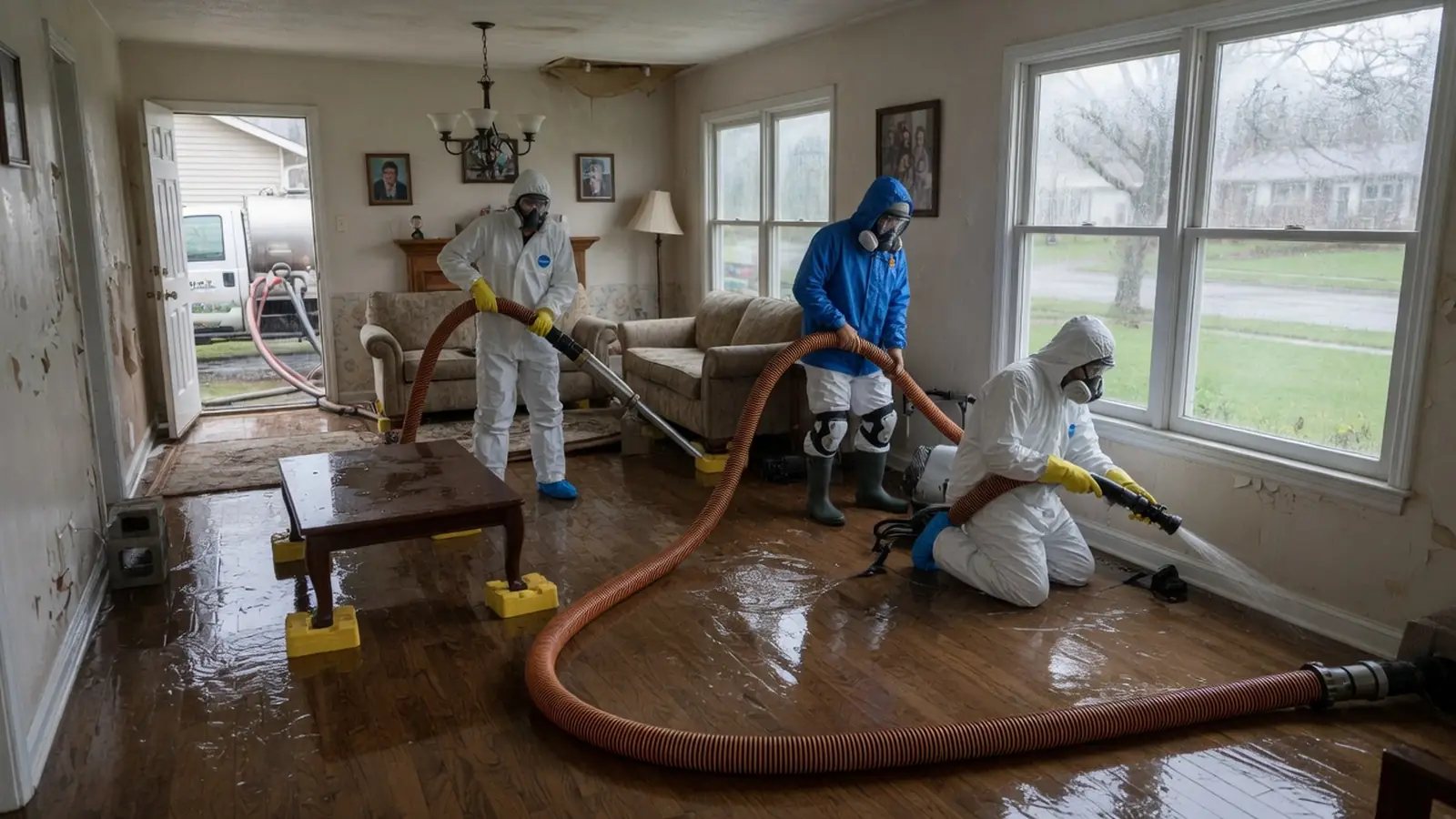
When water surges into finished living spaces or subfloors, swift physical extraction prevents permanent framing rot. Undetected plumbing supply line breaks inside crawl spaces produce severe mold growth across structural floor joists and subflooring if left unaddressed. Our emergency drying protocols stabilize moisture levels before structural decay takes hold.
If water is still coming in, call (252) 555-0127.
Prefer to talk? (252) 555-0127
Dedicated Structural Drying Specialists
Our restoration technicians bring specialized industrial equipment to mitigate acute residential and commercial moisture crises across Pitt County.
About 10% of housing units in the local market (4,167 of 43,368) were built before 1960, the era of galvanized steel supply lines and cast iron drains.
About 7% of housing units in our coverage zone (3,058 of 43,368) were built in the 1960s, overlapping the years aluminium branch wiring was installed.
About 24% of housing units in the region (10,451 of 43,368) were built in the 1970s and 1980s, overlapping the years polybutylene supply piping was commonly installed.
About 41% of housing units across the territory (17,676 of 43,368) were built before 1980, the period when asbestos-containing materials and lead paint were still in use.
A pattern echoed in public discussions is that a primary sump pump failure during heavy downpours results in catastrophic basement flooding that saturates finished drywall and subflooring.
Property owners facing sudden storm intrusions can stabilize submerged flooring through rapid flood cleanup before rot spreads.
Every restoration project follows rigorous moisture-mapping standards to guarantee complete dryness behind wall cavities and underneath baseboards.
Our Four-Step Water Extraction And Drying Plan
We execute systematic moisture mitigation to halt secondary water damage.
- Immediate Extraction And Water Removal. NOAA radar recorded 942 hail signatures within about 15 miles of the local area between 2021-2025 (2021: 112, 2022: 205, 2023: 217, 2024: 143, 2025: 265). The heaviest recent hail year around our sector was 2025, with 265 radar hail signatures inside a 15-mile radius, driving roof leaks and sudden interior water surges that require instant truck-mounted extraction.
- Crawl Space Framing And Soil Remediation. Drying crawl space framing requires pumping standing water, removing wet fiberglass batts, and maintaining relative humidity below fifty percent before laying a continuous vapor retarder. The single most extensive soil unit mapped around our county survey is Exum fine sandy loam, 0 to 1 percent slopes, covering about 32,287 acres of NC147. Furthermore, the dominant mapped soils in the NC147 survey by acreage are Exum fine sandy loam, 0 to 1 percent slopes; Coxville fine sandy loam; Wagram loamy sand, 0 to 6 percent slopes; Bibb complex. Homeowners often describe how elevated wood moisture content and fungal growth in crawl space framing cause homes to fail mandatory pre-sale structural inspections, making our process of extracting subfloor standing water from wet crawl spaces vital for real estate compliance.
- Moisture Wicking Assessment And Cavity Drying. Moisture wicking up interior drywall after a plumbing leak raises urgent questions about whether air drying is sufficient or if drywall must be cut out to stop mold. Public homeowner discussions frequently debate this dilemma, which is why our technicians perform precision flood cuts and thermal imaging to safely preserve or remove saturated sheetrock.
- Hardwood Floor And Subfloor Stabilization. Can particle board or hardwood flooring be saved if floodwaters recede within twenty-four hours? Our technicians deploy targeted commercial injectidry mats and commercial desiccant dehumidifiers directly over tongue-and-groove joints to extract trapped vapor before delamination occurs.
Science-Backed Moisture Mitigation
Why are my hardwood floorboards cupping upstairs when there are no plumbing leaks visible in the living areas? Our master technicians understand that warm humid air rising through interstitial chases creates vapor differentials that warp finished timber floors from below. We protect your home with calibrated moisture meters and complete structural psychrometric drying, and you can learn more about our containment and sanitization standards across all 6 service areas in Pitt County.
Structural Floodwater Extraction
High-capacity submersible pumps and truck-mounted extractors remove standing water from finished floors and crawl spaces within hours. Fast containment protects foundation footings and prevents framing saturation.
Crawl Space Moisture Mitigation
We pump pooled runoff from dirt crawl spaces, strip contaminated fiberglass batts, and deploy dehumidification systems. A sealed vapor retarder is installed to maintain low relative humidity.
Drywall And Flooring Restorative Drying
Using commercial air movers, injectidry floor panels, and desiccant drying units, we dry subfloors and wall cavities in place. We minimize structural tear-outs whenever wood moisture content can be safely stabilized.
Our Commitment To Verified Structural Drying
We approach every water intrusion event with scientific psychrometric protocols and calibrated moisture meters. You can expect transparent communication, respectful care of your property, and disciplined extraction procedures designed to protect framing integrity without unnecessary structural demolition.
- 14Zip Codes Served
- 6Service Areas
- 3Services Offered
Local homeowners rely on our dedicated restoration technicians when unexpected moisture threatens their structural foundations. Read verified feedback from property owners who experienced our rapid extraction, framing drying, and meticulous site cleanup firsthand.
“When a hidden pipe leak failed our pre-sale wood moisture inspection, the team stepped in immediately. They documented all drying logs according to regional structural guidelines and had our clearance paperwork fully signed off without delays. Their compliance diligence saved our closing date.”
Marcus T.
“Our basement began flooding late on a Sunday night during severe storms, and the crew arrived within forty-five minutes of my call. They quickly set up high-capacity pumps to remove standing water before it penetrated our finished baseboards. Having real professionals respond after midnight gave us tremendous peace of mind.”
Brenda K.
“Following water damage along our hallway, this company pulled up the damp subfloor and replaced the wet insulation seamlessly. The new subfloor seams were perfectly flush and level with our existing hardwood joists without any floor squeaks. You cannot even tell where the emergency opening was made.”
Derrick S.
“After seeing how thoroughly the crew dried our crawl space framing and replaced the vapor retarder, I told my next-door neighbor to call them for her plumbing leak. She hired them the following afternoon and experienced the exact same prompt, honest service. I will keep recommending them to anyone facing unexpected water intrusion.”
Elena V.
Frequently Asked Questions
Can water-damaged hardwood or particle board flooring be restored?
Hardwood flooring can often be salvaged if dried within 24 hours, whereas particle board disintegrates when soaked and requires complete replacement. Solid timber can be rescued if water extraction and pressurized dehumidification begin promptly before the cellular structure swells permanently.
Does damp drywall always need to be cut out after a plumbing leak?
Drywall must be cut out if sewage or insulation is contaminated, but clean water wicking can sometimes be dried in place within forty-eight hours. Technicians use non-invasive moisture meters and flood cuts two feet above the waterline to ensure hidden mold colonies cannot establish behind baseboards.
How long does crawl space water extraction and drying take?
Pumping pooled crawl space water takes several hours, while structural timber framing typically requires three to five days of continuous drying. Industrial air scrubbers and commercial dehumidifiers run around the clock until structural wood moisture content drops below fifteen percent.
Why do second-story hardwood floors cup without plumbing leaks?
Upper floorboards cup when crawl space moisture migrates upward through wall chases, creating steep humidity imbalances across timber surfaces. Moisture naturally moves from humid ground levels toward conditioned upper rooms, swelling the underside of tongue-and-groove boards until they expand.
What is the risk of delaying water extraction in older homes?
Delaying water extraction causes structural framing rot, mold proliferation, and hazardous disturbance of older lead paint or asbestos insulation. Properties built before 1980 require careful containment during moisture remediation so that aging materials remain undisturbed while framing dries.